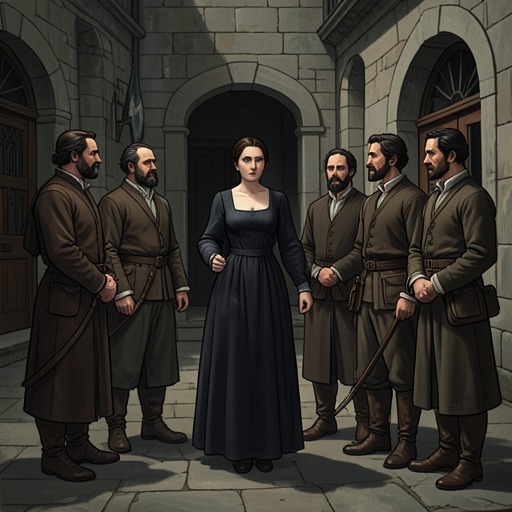
Mary Tudor
Wolf HallMary Tudor, the only surviving child of Henry VIII and Katherine of Aragon, stands at the intersection of dynastic hope and political exclusion. Her survival after the deaths of her brothers and infant sisters gives her a claim to England that her father’s campaign to end his marriage puts in doubt. The novel presents her not as a passive emblem of that crisis but as a clever, watchful young woman who can recognize the consequences of political language even when the adults around her try to soften them.
Identity and dynastic background
Mary is born in 1516, small but vigorous, after a series of failed pregnancies. The cardinal recalls a son born prematurely at the turn of the year, whom he held for less than an hour; the child lived for fifty-two days, and Wolsey counted each one. Another boy died within an hour, a male pregnancy ended in miscarriage, and a little princess survived only a few days. Mary is the surviving result of Katherine’s repeated attempts to provide Henry with an heir, and the contrast between her continued life and the lost children gives her existence a precarious weight.
Henry measures that survival against the Tudor family’s need for a male successor. He asks why, after twenty years of marriage, he has been left with one frail daughter whom a chance wind might destroy. Yet the account also shows that this description is his political and dynastic judgment, not an objective measure of Mary: she is small, but vigorous, clever, and capable of speaking with more gravity than many bishops. The gap between her capacities and the diminished value her father assigns her exposes the gendered stakes of succession.
Childhood, character, and education in power
Before she is ten, Mary is sent to Ludlow to hold court as Princess of Wales. The place is bound to Katherine’s own history: she had gone there as a bride, her husband Arthur died there, and she herself nearly died during an epidemic. When Mary falls ill, weakened and forgotten, the old king’s wife pays from her private purse to have her brought back to London in a litter, a painful day’s journey at a time. Katherine hides her grief at parting from her daughter, but the separation gives their political conflict a personal cost.
Cromwell sees Mary at court and compares her size to that of his daughter Anne, who is two or three years younger. The comparison does not make Mary childish in manner. She is described as a pale, clever doll with fox-coloured hair, speaking with a gravity unusual even among bishops. Her sharp judgments are also evident in her exchanges with Katherine and Cromwell: when the king’s claimed authority over the church is defended through a qualification, Mary asks whether what has been defined can be redefined. She understands that a carefully framed formula may preserve room for a later reversal.
Marriage crisis and the succession question
In May 1527, Wolsey opens a secret court of inquiry at York Place to examine the validity of Henry’s marriage. Katherine is not required to appear or be represented, and is not meant to know of the proceeding, although news of it has reached Europe. Henry supplies the dispensation that allowed him to marry his brother’s widow, confident that the court will find it defective. Wolsey sees the inquiry as a preparatory move, not a final settlement: Katherine can appeal to Rome, and the church’s position against dissolving established marriages or making children illegitimate remains a substantial obstacle.
The royal dispute is driven in part by Henry’s belief that his marriage has failed to produce the succession he expects. The novel counters his sense of divine punishment with the material causes of infant death: disease, hunger, war, rat-bites, bad air, plague, bad harvests, and careless nursing. Mary’s survival therefore cannot settle the succession question by itself. She is living proof that the marriage produced a child, but Henry’s insistence on a male heir allows him to treat that child as insufficient and to place the validity of her birth under political pressure.
Katherine’s account of the crisis makes clear that Mary’s position is also bound up with her mother’s status. Katherine accuses Wolsey of using spies in her household and of trying to remove her from the king’s confidence; Wolsey denies having barred her from the Spanish ambassador, explaining that he wanted to prevent private influence over her. The disagreement reveals a court in which access, information, and family loyalty are part of the contest over the marriage. Katherine’s refusal to cooperate is not simply a dispute with the cardinal: she sees that yielding could cost her the estate of wife and place her daughter’s legitimacy in jeopardy.
Recognizing the new order
In a later conversation with Katherine, Mary hears her mother explain that the king has been named head of the church in England and that a qualifying phrase has been inserted to soothe the bishops. Mary asks what the phrase means and, on hearing that it means nothing, answers that it is clever. Her insight is more exact than the reassuring language offered by Cromwell: definitions can be altered, and a settlement presented as limited need not remain limited. When Katherine points out that the law could be redefined in the church’s favour if she gives up her position as queen and wife, Mary is present as both daughter and attentive political observer.
The conversation also shows the new institutions pressing upon the old religious and familial order. Katherine calls the demand for payment from the clergy extortion, while Cromwell distinguishes the levy as a benevolence. She regards the claim that Henry is head of the church as an attack on the church’s authority; Mary states the opposing principle, that the Pope is head of the church everywhere and that lawful government flows from the throne of Saint Peter. The exchange places Mary’s understanding within a conflict among royal power, parliamentary action, and papal jurisdiction, rather than reducing her outlook to filial loyalty alone.
Cromwell responds to Mary as a person as well as a political concern. When she folds at the knees in the heat, he catches her and eases her onto a stool, telling her she need not be ashamed. Her gratitude disappears as soon as she is seated, replaced by an expression as stony as a besieged town. He also asks her to stop speaking ill of Wolsey, her godfather, and reminds her that she owes him affection. Mary’s sharpness and her capacity to receive kindness coexist; neither makes her cease to judge the political arrangements around her.
A contested future
Mary’s succession remains uncertain as Henry seeks to secure the inheritance of Anne Boleyn’s children. Cromwell tells Katherine that if Anne has no children, Henry may confirm Mary as his heir, and urges Katherine to conciliate the king rather than reject every chance of reconciliation. The argument makes Mary’s future conditional on events beyond her control: her father’s marriage, Anne’s fertility, Katherine’s willingness to yield, and the political settlement that the king may choose to recognize.
In the debate over the king’s authority, Cromwell invokes Marsiglio of Padua to argue that princes govern their subjects and that Parliament, acting for the people, supplies the legislative basis of kingship. The prince, in this account, has authority to determine who is married, who may marry, and who is legitimate. Those questions are not abstractions for Mary. They bear directly on whether her parents’ marriage is valid and whether she remains eligible to inherit. The novel’s political argument therefore returns to the daughter whose birth was once celebrated as a dynastic answer, but whose standing can be recast by the same laws that claim to define the realm.
Mary’s character is marked by this tension between vulnerability and judgment. She has suffered illness and separation, and the political choices made around her threaten both her mother’s position and her own. Yet she notices the instability concealed in official wording and speaks plainly about the authorities at stake. Her significance lies in the way the succession crisis becomes visible through her: a living princess can be at once cherished, diminished, and made conditional by a government deciding who has the power to name a marriage, a church, and an heir.